Beginner’s iNav build academy: 1. Introducing the Dolphin
This is my first time making a build series; so I want to try and do it right. This beginner’s iNav build academy will be a playlist of videos on YouTube, and accompanying articles here. Ideally, these resources should cover all questions, and get a new iNav Pilot ready to maiden their new airplane. I this first article, we will take a look at the AtomRC Dolphin, why I chose this particular model, and have a look at some components for the build.
The playlist of videos is the iNav 5.0 Beginner’s Build Academy.
Picking the right plane for the beginner’s iNav build academy
This was not a task that I took lightly. Not so many years ago, build academy were made with either a Reptile S800 or SonicModell AR Wing. These were both cheap, around £35 to £50 for the kit. The S800 was virtually indestructible, and the AR Wing more spacious. So both had their merits. I built my first FPV plane following Matt Ogborne’s S800 build series on Rag the Nuts Off. Now 5 years on, there are more planes on the market, more flight controller, more everything to be honest. We’re also at a time where models have become more expensive due to circumstances brought on by CoViD-19. The cost of shipping alone has increased massively; and it will likely be years before it gets back to pre-CoViD costs, if ever.
Another thing with flying wings; they look cool, but they’re not the easiest planes to launch. They’re not the easiest planes to fly, and getting the CG right has less tolerance than with a traditional plane. So they’re not really the best choice for a first model; despite how well they can take a beating. Failure to launch, or repairing all the time only leads to frustration. What we want is a good experience, and lots of time in the air. So the challenge was to pick something that:
- looks cool
- is beginner friendly in the air
- launches easier than a flying wing
- is cheap
- and is easy to build
The AtomRC Dolphin
I decided to pick the AtomRC Dolphin for my beginner’s iNav academy. This plane ticks most of those boxes. It looks pretty cool, it has forward swept wings after all. Planes with this layout always have a cool silhouette in the sky. It has grips on the bottom to help with launching. The bays on this thing are big, so there is plenty of space to work. This should ensure an easy build. A lot of the kit is already built too. The price, though not dirt cheap like the old S800, is pretty average with today’s prices. I paid £75 for the kit version from a shop in the UK (where I live). The PnP version is also available from the same seller for £100.

The most important part was how well this thing flies. Being a forward swept wing, it should have good stall tendencies. But watching lots of review videos, and asking advice from fellow RC pilots who have them, put my mind at ease that this is the right choice. It has a large flight envelope. It can be docile and fly around at 25-30 mph, or it is happy to pick up the pace too. This plane gets a thumbs up from Andrew Newton, Matt Ogborne, and Painless 360, to name a few. I have also maidened a Dolphin, and it flew beautifully.
There are 3 version of the AtomRC Dolphin available. There is a Lite version, which is the same as the kit version, but everything is unbuilt. If you are a beginner, I would avoid this version. To be honest, with the layout of the kit, there’s not really any reason to get the Lite version. The other two versions are the same, one uses white foam, the other black foam. Both the black and white version can be bought as a kit or PnP. There is also an FPV version. But, for a little more, you could get the same FPV camera and a better VTx.
PnP vs Kit
This decision I will leave up to you. You will be able to follow the build series the same whether you choose the PnP or kit version If you are completely new to this, the PnP may be a better choice, as the parts are already selected for you.
Me personally, I decided to go for the kit version. This will be more expensive than the PnP version. But I have heard bad things about the servos and ESC in the PnP version. However, other pilots have not had problems. So I will leave that up to you. I will be listing alternate parts in this article to go with the kit version. It will be a similar spec, but better quality components.
Unboxing the Dolphin
The actual unboxing is in the iNav 5.0 Beginner’s Build Academy: Lesson 01 – Introduction to the series & plane video. But, I thought this section could be useful for notes, extra info, and to answer any questions about the plane.
Since recording the video, I did find a slightly more in-depth manual. But still, the important throws information is not in this manual. It can be found on the AtomRC web site.
Gone for the Kit. What parts should you buy?
Lets start at the back of the plane and work our way forwards. The first things not included in the kit is the motor and prop.
Motor and Prop
The motor that comes with the PnP actually seems to be a pretty nice all rounder. It’s not the most efficient, and not the fastest. But seems like as good a place to start as any. So we’re looking for around a 2306 size motor, starting at 2000KV. Up to 2500KV would be fine too. The prop that comes with the PnP kit is a strange size, 5.1 x 5.2. For this size motor, a 6 x 4 or 5 x 5 prop may be a good option; they are much easier to get hold of. My go-to prop is usually a genuine APC-e propeller for applications like this.

However, there is one thing to bear in mind when using quad motors. A lot of these motors are designed to be used with flat props. This is fine if our airplane was a tractor configuration (motors facing forwards). But for a pusher, this means that sometimes the humps on the APC-e prop’s profile can touch the bell. Even worse, the can stop the prop seating properly on the motor. Potentially, a 2-3mm aluminium spacer could be used.
I would not recommend using quad props. They are a lot more flexible, and designed more for torque. But, there are other brands of airplane props that are flat on the side that would be closest to the bell. For example Master Airscrew, and Graupner Super CAM propellers.
Feel free to choose your own motor. Below are some examples, close to the PnP.
EMAX ECO Series II
£9.95 (UnmannedTech) | €11.70 | USD$12.30

The EMAX ECO Series II has a 2306 2400KV motor, is towards the high end of our KV range. A 5.25 x 5.5, 6 x 4, or 6 x 5 could be used on this motor, or larger with testing. This is quite a budget motor, but Paweł Spychalski is using this type a lot now, and rates them.
- Cell count: 3S – 6S
- Max Watts: 740
- Max Amps: 44
- Mounting pattern: 16 x 16 mm
KO Technologies Demon Seed
£11.95 | €13.99 (KO Technologies) | US$14.99 (KO Technologies)

The Demon Seed doesn’t quite match the stock specs. It has a 2208 stator, so 1mm smaller in diameter, but 2mm taller. This may equate to slightly more torque than the bigger diameter, but shorter motors. The nearest is a 2050KV.
- Cell count: 4S – 6S
- Max Watts:
- Max Amps:
- Mounting pattern: 16 x 16 mm
There are no max watts or amp figures for the KO motors. But, they are very well tested in the development phase. Plus KO Technologies pride themselves as going above and beyond the specs of the competition motors.
iFlight XING 2306 2450KV
£16.39 (UnmannedTech) | €19.20 | US$20.20

XING motors are known to be pretty decent. Another higher KV motor, and a bit more of a higher price.
- Cell count: 4S – 6S
- Max Watts: 748
- Max Amps: 44
- Mounting pattern: 16 x 16 mm
KO Technologies Method F Spec 2307.5 or R Spec 2207.5
£14.50 | €16.99 (KO Technologies) | US$17.99 (KO Technologies)
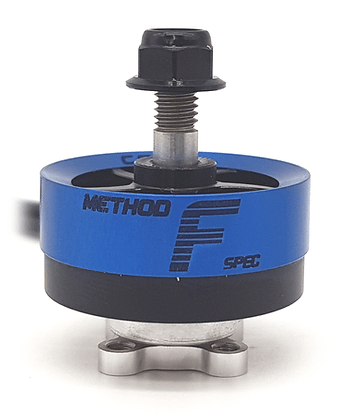
KO are known for making very well spec’d motors, that are extensively tested. These motors often out-perform similar size and spec motors. The Method R is a 2000KV motor; whereas the Method F can be bought in 2000KV or 2540KV.
- Cell count: 4S – 6S
- Max Watts:
- Max Amps:
- Mounting pattern: 16 x 16 mm
T-Motor F40PRO IV 2400KV
£19.95 (UnmannedTech) | €23.40 | US$24.60

The F40PRO is a 2306 stator motor. This motor is rated for 4S to 6S power. Another motor that is higher up in the KV range. This is a more expensive motor, but will be no doubt made from better quality components.
- Cell count: 4S – 6S
- Max Watts: 666
- Max Amps: 42
- Mounting pattern: 16 x 16 mm
T-Motor AT2310 2200KV

£23.35 (HobbyRC) | €27.30 | US$28.80
The AT2310 is a larger motor. A friend of mine has this motor on his Dolphin. It has plenty of thrust, can fly 100 mph, but has less flight time compared to the PnP motor on the same battery. It is worth noting that this is the only fixed wing motor in the list; so will be heavier, but able to sustain high power for longer. Another thing to note is that this motor has a 16 x 19mm bolt pattern. So more work, or a 3D printed motor mount will be needed with this motor.
- Cell count: 3S – 4S
- Max Watts: 650
- Max Amps: 45
- Mounting pattern: 16 x 19 mm
ESC
The PnP version comes with a basic 30A ESC with a 3A BEC. The ESC was one of the PnP parts considered weak. With this build, we will be using a fixed wing flight controller, so don’t need a BEC. The ESC bay is 24mm wide by 50mm long. So we need an ESC that will fit in here. Also, we can see that with that size motor, they can all hit around 40A, depending on the setup. So 30A may be a bit low. Of course, cruising will be much closer to 3-6A. What can be useful, though not by any means essential, is ESC telemetry. To use this with iNav, we need an ESC with a telemetry pad. These will almost certainly be BLHeli_32 ESCs, which also support DSHOT.
As with the motor; feel free to choose your own ESC. Below are some options.
iFlight SucceX-E Slick 45A
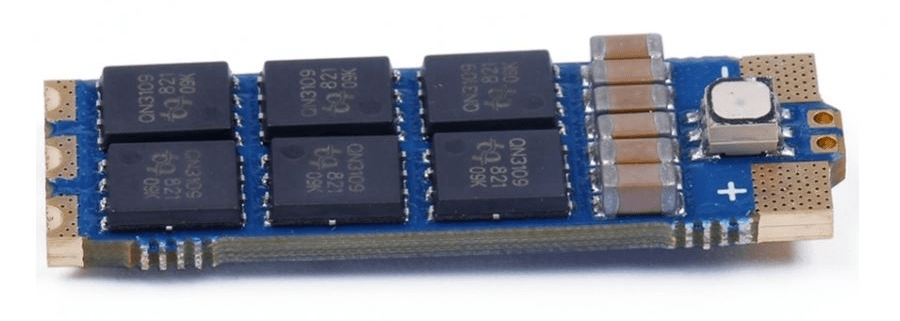
£12.60 (HobbyRC) | €14.80 | US$15.50
The iFlight SucceX-E is a 40A ESC with a burst rating of 45A. It can handle 2S to 6S power and it is pretty small at 34 x 10 mm. So we may have enough room in the bay for the ESC and a 220uF 35V low ESR capacitor.
Holybro Tekko32 F4 45A
£17.99 (3DXR) | €21.00 | US$21.20
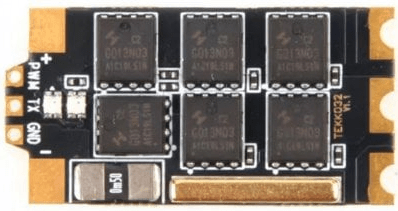
The Holybro Tekko32 range of ESCs are pretty well regarded. The are small and capable ESCs. This version has a rating of 45 A. It can handle 2S to 6S batteries. Plus, it is small at 32mm by 17mm. With this ESC, Holybro only say to use a capacitor with 6S. But these ESCs are designed for use with quads, which have very short power leads. On a fixed wing, the power leads are much longer; so a capacitor will be beneficial.
iFlight SucceX Slick 55A
£31.95 (HobbyRC) | €37.40 | US$39.40
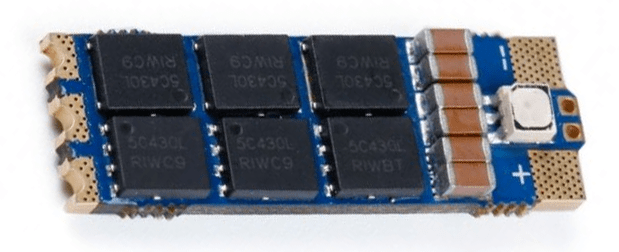
This is a higher power version of the 45A ESC. This time the constant rating is 55A with a burst of 60A. It is only 35 x 11 mm, so not much larger than the 45A version. Again, a 220uF 35V low ESR capacitor is recommended.
Servos
The PnP servos are just very basic, plastic geared servos. Better servos will improve the way your plane flies, no question. The servos in the kit are listed as 9g servos. This is a generic term, but also misleading; as the equivalent metal geared servo will weigh around 13g.
Fake TowerPro MG90S
In the past, people have recommended the clone TowerPro MG90S. But they are absolute junk. Quality varies from bad to terrible. They don’t even meet the low specs that they advertise. Don’t waste your money on these servos.
GDW DS031MG
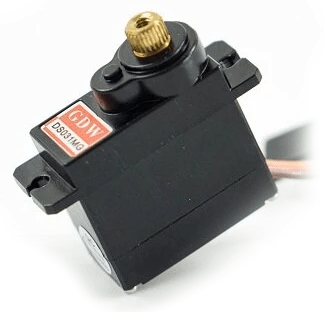
£5.99 (UnmannedTech) | €7.00 | US$7.40
GDW are a Chinese manufacturer, who produce some good servos. They have quite a few mid priced, aluminium cased servos. But this plastic cased servos is also pretty good. It is spec’d to work at 333Hz data frequency too.
- Size: 22 x 12 x 24 mm
- Weight: 12g
| 4.8V | 6V | |
|---|---|---|
| Torque | 2.25 kgf/cm | 2.7 kgf/cm |
| Speed | 0.13 s/60 degrees | 0.11 s/60 degrees |
EMAX ES08MD II
£6.55 (3DXR) | €7.70 | US$8.10
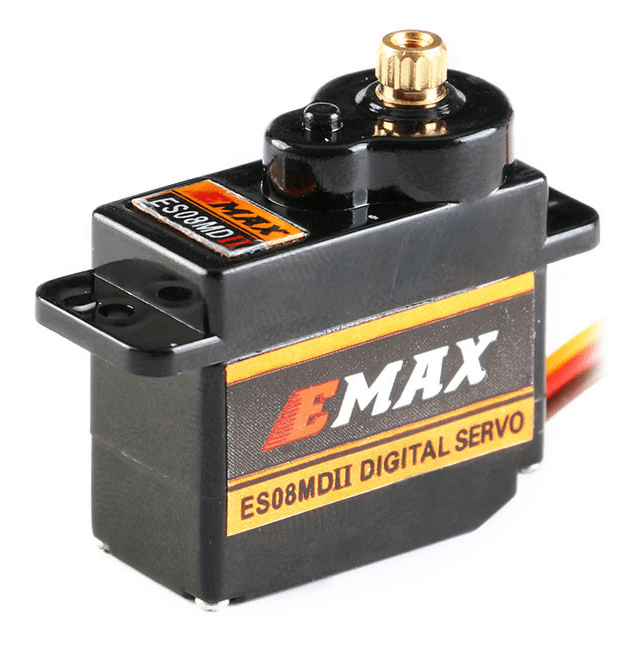
If I’m being completely honest with you all. This is the worst servo I’d put in a plane. I’m not saying these are bad servos. Actually, for the price they are very good. But, I wouldn’t use anything less than these. They meet or exceed their specs, and have Nobel potentiometers, which are very decent. This is definitely a good, cheap servo. The only downside to these servos is there is no specifications for the data frequency.
- Size: 23 x 11.5 x 24 mm
- Weight: 12g
| 4.8V | 6V | |
|---|---|---|
| Torque | 1.6 kgf/cm | 2.0 kgf/cm |
| Speed | 0.12 s/60 degrees | 0.10 s/60 degrees |
JX PDI1109MG
£6.90 (3DXR) | €8.10 | US$8.50
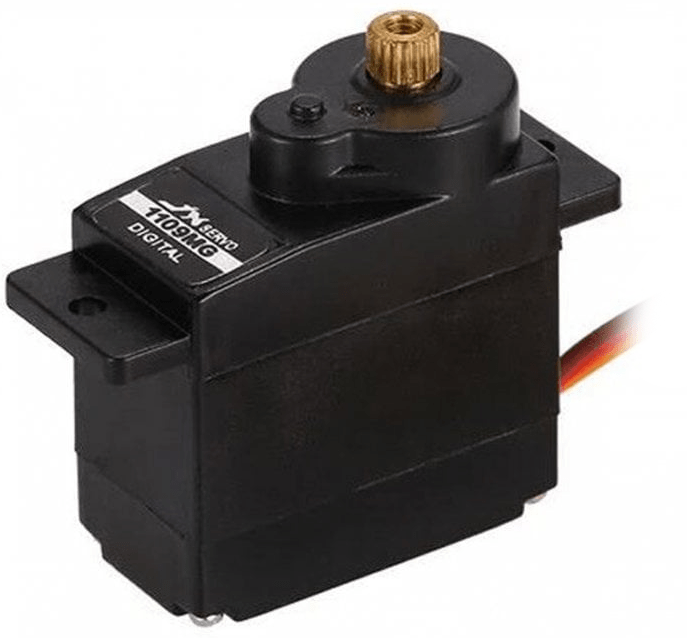
The PDI1109MG is a similar spec to the ES08MD II. The speed rating is the same. But this servo can provide more torque. In fact, the torque is close to the more expensive ES09MD below. So this is a nice halfway house between the two. But, there are a couple of advantages. Firstly, it is 2g lighter, Secondly, it has got a specified 330Hz data rate.
- Size: 23.2 x 12 x 25.5 mm
- Weight: 10g
| 4.8V | 6V | |
|---|---|---|
| Torque | 2.2 kgf/cm | 2.5 kgf/cm |
| Speed | 0.12 s/60 degrees | 0.10 s/60 degrees |
EMAX ES09MD
£8.95 (3DXR) | €10.50 | US$11.00
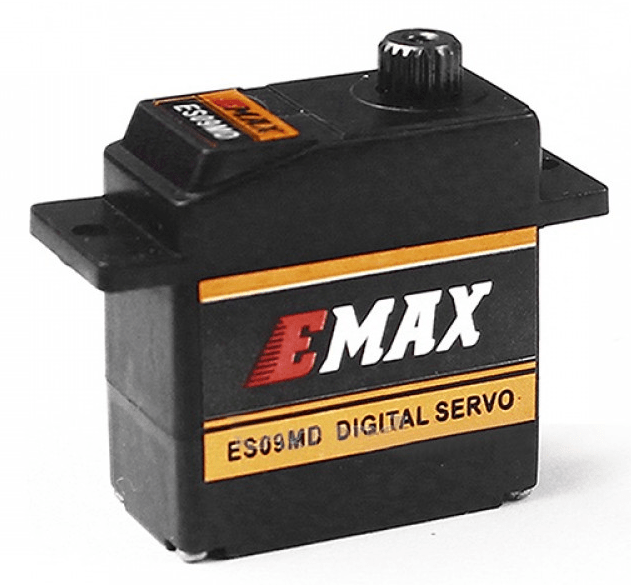
This is a slightly larger, more powerful, and faster servo than the ES08MD II. This servo also has twin bearings. Again, like the ES08MD II, there is no specifications for the data frequency.
- Size: 23 x 12 x 24.5 mm
- Weight: 14.8g
| 4.8V | 6V | |
|---|---|---|
| Torque | 2.3 kgf/cm | 2.6 kgf/cm |
| Speed | 0.10 s/60 degrees | 0.08 s/60 degrees |
Next time
At this point, we now have all the base components for the AtomRC Dolphin. Whether you’ve chosen to go for the PnP, or the kit and get our own components; we now have the same stuff. In the next article in the beginner’s iNav build academy; we will look at the additional parts that we will need for the FPV and iNav side of this build.
All prices in this article were found on 3DXR.co.uk, Banggood.com, HobbyRC.co.uk, UnmannedTech.co.uk, or KO-europe.com on the date the article was written. Prices shown will list the store the price was taken from. If no store is shown, it is a currency conversion made on the same day; rounded to the nearest 0.10. Links to products may be affiliate links, and different prices to those shown on this page.
